I recently participated in a VoiceAPalooza stream panel with Fallout For Hope and Wes Johnson. Along with some of the amazing voice actors and fellow devs of Skywind, I was there to provide some insight and context on the writing processes for our mod, and engage with the fan community in the name of charity.
Like many others, I am protective of my identity online. There’s only so much I can do, ultimately, but I try to do what I can. My Facebook profile pictures have no photos of me, I don’t post selfies, etc. So when I found out that this stream I wanted to participate in was going to be on camera, I had a bit of pause.
Thankfully I had some inspiration from someone I deeply respect and admire: The Elder Memes, a good human being, another voice for the voiceless, and a member of our writing department. I recalled that in years past, they wore a Vault Boy mask at times to conceal their face at certain fan events. With their permission, that became my announced plan. I even wore it to the tech test / meetup before the event.
But the moment this panel first came up, I had a different idea. Not just an idea. A plan. The Vault Boy mask would work, and after all, our host organization would be Fallout for Hope. But “it would work” is not an ideal I strive for where creative endeavors are concerned. Plus, I didn’t want to be derivative. I could do something different. Something original that also spoke more to Skywind and The Elder Scrolls than Fallout.
I reached out to my buddy Bob, a genius artist craftsman type, made my pitch, and the project was underway. A month later after a ton of work, he was finished. With fumes still fresh and just over 24 hours to spare, I held in my hands a 3D printed bespoke Ordinator helm.
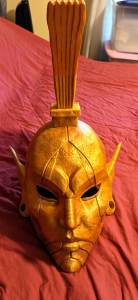
We left space for my headset, but the plan was to use my Bluetooth earbuds to preserve the illusion while maintaining audio quality. Unfortunately, I hadn’t tested the Bluetooth connection on my PC since moving, and the placement of my desktop in my new office made my spoken audio choppy at best.
A test call with the helm and my headset went well; placing the microphone on the surface of the mask picked up my voice decently, if a bit muffled, and I could hear clearly enough inside the helmet. I did a little prep work and was ready to go.
At the start of the stream my audio was quiet, but it was fine. Once we went live, however, it became apparent that background music on the stream, or anyone else speaking, meant that I was too hard to hear. I adjusted my personal volume both digitally and by speaking very loudly, but, alas, it wasn’t enough.
I was faced with a choice I wasn’t happy about. I could keep trying to be heard by speaking at twice my normal volume, or I could try to participate less: this was, after all, primarily a panel of voice actors. I was just lucky to be there. Then the stream chat started to ask more writing questions.
Now, in retrospect, I acknowledge I could have opted to just swap over to the Vault Boy mask — I could be heard quite clearly in it — but I was exhausted, stressed, and dedicated. And, at the end of the day, my protection of my identity is really more a matter of personal privacy than a safety concern of anything of the sort.
So I switched my camera off for a moment while others were talking, and removed the helmet. When I clicked the cam back on I wasn’t wearing a mask of Indoril Nerevar’s visage. I was just me.
Except… that’s not entirely true. Yes, that was my real face and voice on stream — no deepfake trickery or anything like that. But the title of this essay has another meaning, the true reason that I’m penning this missive right now.
In late April I retweeted Wes’s call to action with some comments. I said that as a writer, I don’t have words for how awful Alzheimer’s and dementia are. I said that I’ve tried to find them. I thanked Wes and everyone involved for giving a voice to a wordless dread. I said I wasn’t going to take up digital space on that thread by talking about my own experience, and asked folks to help.
That’s the other mask. That’s the mask of TwoBitMatt, your friendly neighborhood Lore Dad, affable but sardonic nerd, an aloof advocate happy to promote just causes and cool projects while keeping a measured personal distance for my own protection. Not that any of that is insincere, but it’s not me, not in full. It’s the persona that I act through online while engaging with fan communities of mutual interests, the voice I’m writing in right now, the second skin of comfort and familiarity that stops anyone from looking too closely or trying to peek behind the curtain.
Behind the mask.
So. Here’s the truth. Here’s my truth. My family’s truth.
My father has dementia. My mother is his full time caregiver. This disease has not only robbed my father of his mind and will, it has stolen years of peace and joy from all who love him. It has ravaged our hearts as it has ravaged his memories.
Growing up, my stoicism and intellectual drive came primarily from my dad. My mom gets credit for me being at least a somewhat socially adjusted human, but my old man gets the blame for my love of history, my voracious appetite for learning about other cultures, and my fascinations with technology and gaming. My patience, my sense of honor and duty, my dedication to family, are all things he helped nurture and encourage.
All of these are now missing pieces of the puzzle that is my father’s present mind.
This guy that used to race his souped up Saab Sonett can’t drive anymore.
The engineer who worked on space shuttles and aircraft carriers can’t follow the directions in a Lego set.
The patient stoic who always cautioned me to step back when angry (“Games are about fun. If you’re not having fun, put down the controller and take a break.”) has a temper that can flash as quickly as its trigger can be forgotten.
I said that I don’t have words for how awful this is. These are just a few of them. I won’t subject myself or anyone else reading this to a more exhaustive list — instead, I wish to share what tools, perspectives, and lessons I’ve learned as this disease has decimated my father and our family.
Therapy isn’t for everyone. It can take a number of tries before you find the right therapist or counselor. For me, having the space to safely vent and reflect was the kind of accommodation I needed to process what I was going through. Therapy helped me realize that my struggle was not just a matter of being sad about what was happening; it was grief and mourning for a parent who was still alive, but in many ways, gone.
Like all grief, it comes and goes. Much like my father’s lucidity, and often tied to its ebbs and flows, I have days where I am able to focus on how lucky I am to have known such a man. Other days, I am morose, inconsolable, consumed by the painful reality that my children and my wife will never be able to know my father as I knew him. The vibrant, studious, focused mind that I know is something they’ve never seen or been able to learn from. My mother is constantly consumed with doctor’s appointments, medication reminders, and balancing the internal tumult she feels with the outward patience she maintains, and I always feel like I am not doing enough — cannot do enough — to help.
Yet, just as I hope that this confession might help others, I know that my own reflection and contemplation on the devastation of this disease will continue to inform my thoughts and actions as a father, husband, son, and human being. His influence, and my mother’s, continue to encourage me to do more, be more. They were my motivation to join this stream effort with Wes and the others. I am happy to promote Skywind, and delighted to have the opportunity to be on a panel of so many talented individuals. At the end of the day, though, I was on that panel for my family, and all the other victims and caregivers impacted by this exhausting, agonizing, excruciating disease.
That’s why I took off the helm, and why I’m writing this now. Dementia is a funerary mask worn by millions. People like me who carry on day-to-day without indicating to the wider world the pain and sadness they face within. People like my mother who project strength and boundless love while hiding the struggle of daily life caring for the shadow of the person they love. Most of all, people like my father who are shrouded in the pall of their disease, aware that their mind and memory are being stolen, while unable to remove the veil except for the briefest moments of fleeting clarity.
It’s far too late for my father — and so many others — but it’s not too late for generations to come. As much as it hurts, as pained as we are, as much as we struggle to hide our sorrow and bewilderment and resentment of a cruel reality we feel helpless to fight against, we all have to look behind the mask and confront these hard truths.
We are capable, as a species, of banding together to obliterate a disease that abbreviates our cognition, suppresses our capacity, and dulls our souls. Just like I desperately want my father to recognize what should be familiar, I desperately want humanity to recognize that we are capable of preventing these experiences for our children.
I feel helpless to save my father, but I have hope for the future. For the sakes of all who have suffered from this insidious terror that steals minds and souls, for the generations to come, we must unite in the battle against this affliction.
 TwoBitMatt.com
Comments are closed.